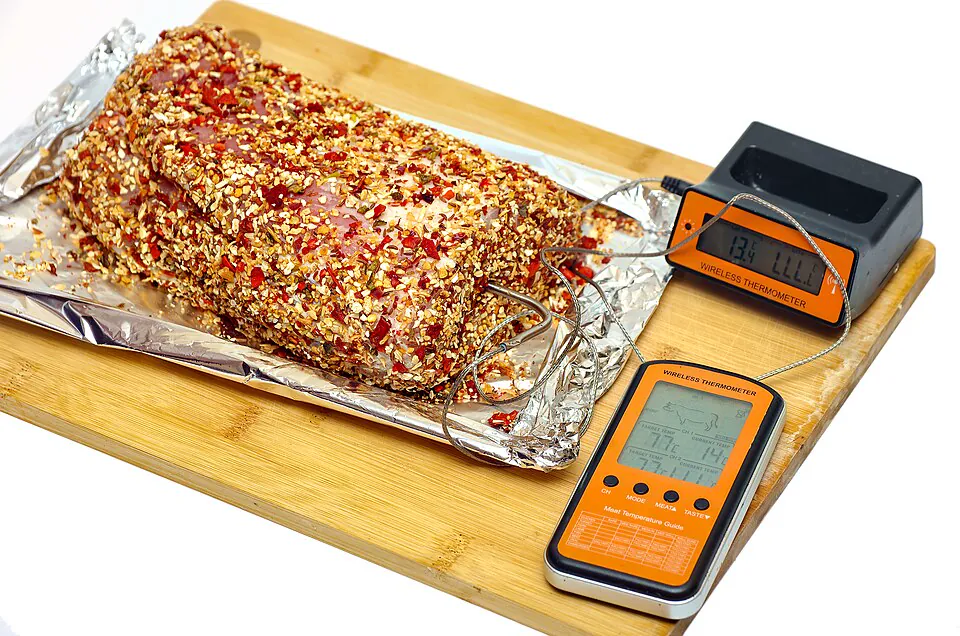
Treat yield as a range until you weigh your own result. Record raw package weight, removed trim, cooked rested weight, method, doneness, and whether juices or rendered fat were used; then reuse that observation only for a genuinely similar cut and process.
Do not combine every loss into one mystery number
Trim loss happens before cooking; moisture and rendered-fat loss happen during cooking. Keeping them separate shows whether a bone-heavy package or a high-loss method drove the result.
Weigh at consistent checkpoints
Record unopened or labeled package weight, raw weight after discarded trim, and cooked weight after the same resting/draining practice each time. Mixed checkpoints make two batches look different even when the cooking behaved similarly.
Name the method precisely enough to reuse
Pan-seared steak, uncovered roast, covered braise, smoked shoulder, and drained ground meat can produce different results. Note cut thickness, bone-in status, and broad doneness target without pretending one household observation is universal.
Use a low, middle, and high-loss scenario
For a purchase decision, calculate more than one case. The middle case supports the meal plan; the higher-loss case protects an event or fixed guest count; the lower-loss case forecasts leftovers.
Keep safety independent from yield
A shrinkage percentage does not prove doneness. Follow the package and current official guidance and verify the relevant minimum internal temperature and rest time with a thermometer.
| Checkpoint | Record | Why |
|---|---|---|
| Package | Labeled raw weight and total price | Connects result to buying cost |
| After trim | Raw usable weight | Separates bone/trim from cooking |
| After cooking | Rested or consistently drained weight | Measures method loss |
| Meal | Servings actually portioned | Tests the chosen ounces per serving |
| Notes | Cut, method, thickness, doneness, secondary uses | Defines when the result may be reused |
Worked example
Turn one roast into a reusable observation
A 5.0 lb package yields 4.6 lb after discarded trim and 3.4 lb after cooking and resting. Trim/non-edible share = (5.0 − 4.6) ÷ 5.0 = 8%. Cooking shrinkage = (4.6 − 3.4) ÷ 4.6 ≈ 26%.
Combined cooked yield from package = 3.4 ÷ 5.0 = 68%. At 6 cooked oz, 3.4 lb provides about 9.1 planning servings. Record it as one observed result for this cut and method, then test nearby scenarios rather than declaring 68% universal.
Planning ranges are editable assumptions, not universal yields or safety tests. Follow the package and current official guidance. Audit the planning method and sources · return to the planning hub.